
The Curvature
Simultaneity, Individuation, and the Illusion of Return

The Wrong Question
For your consideration: a question that survives every explanation. If time is not what it seems, and continuity is not built from moments, then what—if anything—gives rise to individuality? Tonight’s episode does not ask whether something survives death, but whether survival was ever the right question. You’re about to enter… the Twilight Zone.
A Stable Differentiation
Assume, for a moment, that the sense of being someone is not produced by memory, personality, or history. Assume it is not assembled by linking experiences together across time. Instead, consider that individuality arises from a unique organization within consciousness itself—a stable curvature, a consistent mode of localization through which appearance takes shape.
From within experience, this curvature feels like a familiar vantage point. A sense of “here.” A continuity that does not depend on remembering who you were yesterday. Even when identity loosens, even when narrative collapses, something about this vantage point remains unmistakably itself.
Outside of Time
From the perspective of Total Being and unilocality, there is no persistence in time—because there is no time for anything to persist through. All such curvatures are present simultaneously. Not earlier or later. Not beginning or ending. Simply present as differentiations within a whole that does not move.
What we call a lifetime, then, is not a journey from birth to death, but a particular tuning of conditions through which one of these curvatures becomes visible. Change the conditions, and a different articulation appears. A different body. A different world. A different story. The curvature itself does not go anywhere. It does not return. It does not continue. It simply is.
Seen from within time, this looks like succession. One life following another. A sense of return. A narrative of before and after. Seen outside of time, it looks very different. It looks like simultaneity—multiple expressions of the same organizing principle, all present at once, segmented only when time is introduced as a way of making sense of them.
Simultaneity Mistaken for Sequence
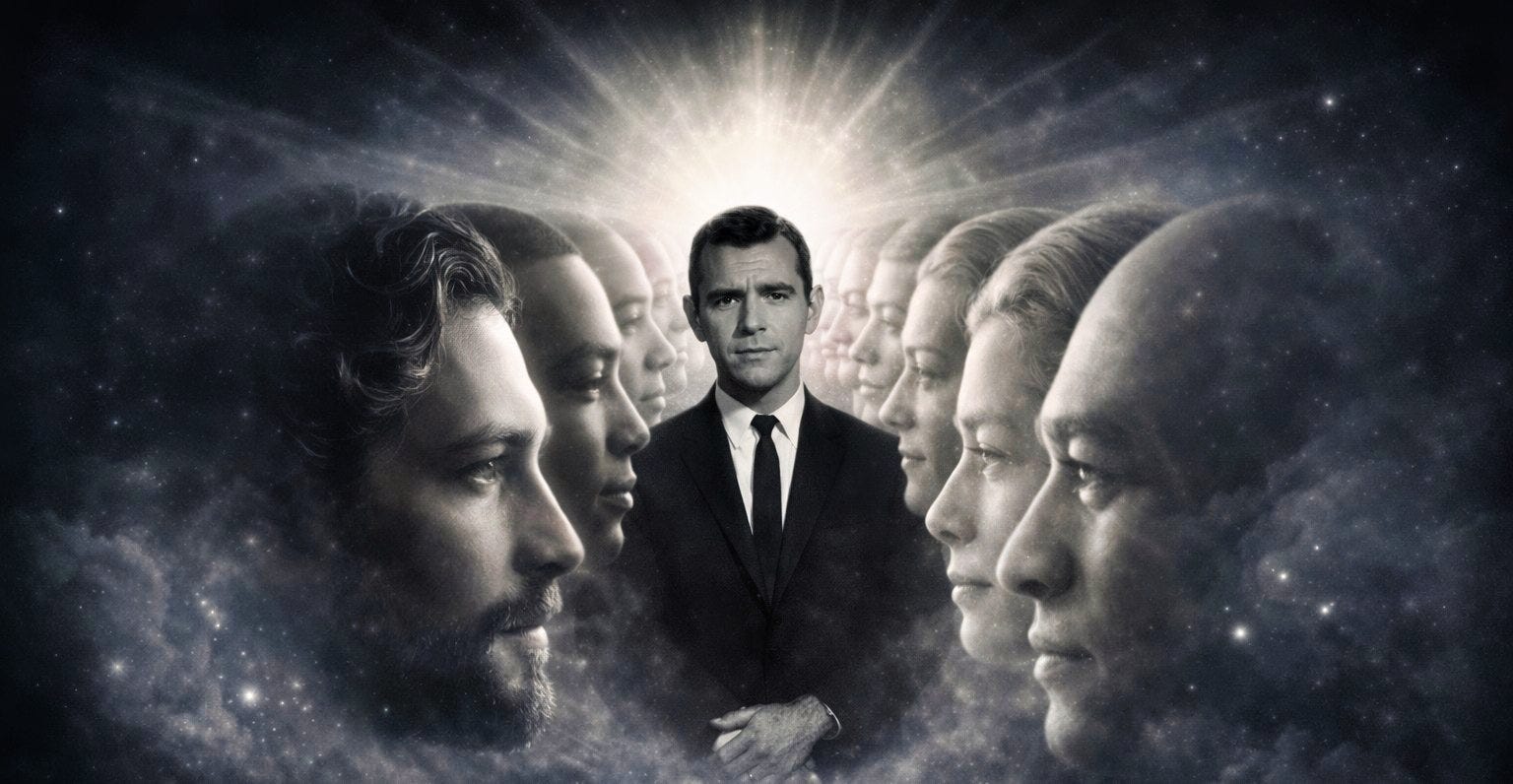
Pause and look at the image accompanying this episode. You may notice what appears to be a sequence—faces receding into the distance, expressions unfolding one after another, a sense of progression implied by depth. But consider another possibility. What if nothing in that image is occurring in time at all? What if every face is present simultaneously, arising from the same point, and what you are interpreting as distance or repetition is simply time being added by the mind?
Perhaps what looks like recurrence is actually co-presence. Perhaps what feels like many lives is differentiation seen through a temporal lens. In that case, the image is not showing lives unfolding, but a single organizing curvature articulated all at once—divided only when time enters the picture.
Reincarnation Reconsidered
In this view, reincarnation is not a soul traveling from one body to another. It is not a self accumulating experience across centuries. It is not return or repetition, but the simultaneous multi-expression of a timeless curvature within Being—misread as sequence when time enters the picture.
There is no progress here. No hierarchy. No earlier or later. Just differentiation without succession, individuality without biography, expression without movement.
The Final Turn
Perhaps what we call a life is not something that happens once, or many times, but something that is always already present—seen one way when time is applied, and another when it is not. Perhaps what feels eternal is not a self that survives, but a curvature.
You’ve just crossed into a region where reincarnation has nothing to do with coming back, where individuality exists without history, and where what you truly are has never moved through time—only through interpretation.
Next stop… the Twilight Zone.
John Harper is the author of The Alchemy of Perception, a contemplative exploration of how reality is shaped not by what we see, but by how perception itself organizes experience. Rather than offering answers, Harper’s work invites a direct reorientation of awareness—revealing how observer, experience, and meaning arise together as a single event. The themes explored here echo that inquiry: perception as alchemy, identity as localization, and reality as disclosed through how it is seen.