
Three Waves, One Elixir
How California became a cradle for modern consciousness


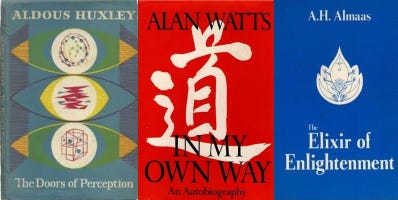
Today I began reading In My Own Way by Alan Watts again. Once more, I was swept into his masterful command of language — the way his words bend light, texture, humor, and metaphysical astonishment into sentences that feel like doorways. His writing doesn’t merely talk about consciousness — it transmits it. The page becomes a window into the living mystery of being.
As I was carried again by that voice, another realization arrived: while Watts was completing this book in the early 1970s, across the Bay in Berkeley, Hameed Ali — soon to be known as A.H. Almaas — was beginning to articulate the inner discoveries that would become the Diamond Approach®.
Two spiritual writers of our time. Two shores of the same Bay. One ocean of consciousness.
A Quiet Emergence Across the Bay
Separated by a generation, they form two waves in a single movement of awakening. Watts was nearing the completion of an extraordinary journey. Almaas was just beginning his. The baton passed — invisibly — without either man needing to reach.
Watts spent his final years in Marin County — houseboats and redwoods, fog and mythic atmosphere — drawn to the soft edges where land and water dissolve. He had little patience for the industrial bustle of Oakland or Berkeley, which he felt represented a mechanical trance and the commodification of human life. He craved wildness, spontaneity, and wonder.
And yet, in that very Berkeley landscape he resisted, Almaas was undergoing a profound spiritual flowering — awakened by inner experience rather than inherited doctrine — studying physics, later psychology, and mapping the phenomenology of realization from the inside out.
Two Men Facing the Same Vastness
Two men.
Back-to-back.
Facing into the same vastness.
The First Wave
To feel the larger arc, it helps to look one wave further out — to the arrival of Aldous Huxley in Southern California in the 1930s. Not in the Bay Area, but deeply embedded in the cultural shift of California itself. Huxley brought a towering intellect and mystical sensitivity — using language not as explanation but revelation. Like Watts after him, he wrote with the intelligence of a philosopher and the soul of a poet.
Watts followed Huxley’s wake yet made the ocean dance. Together, their writing opened “the doors of perception” with radiant imagery, metaphors that breathed, and sentences that shimmered with direct transmission. They wrote as if consciousness itself were reaching through them.
The Elixir Distilled
Almaas, by contrast, writes with surgical clarity — the precision of a mystic scientist. His work reveals the structures of awakening: how identity forms, how it relaxes, how Being unfolds into presence, love, clarity, and freedom. His writing is the elixir distilled — the physics and phenomenology of liberation.
Huxley arrived first — blazing open the psyche’s outer edges.
Watts followed — translating East and West into lived immediacy.
Almaas emerged — revealing how realization takes root in the ground of our humanity.
One dissolves the walls.
One laughs as they fall away.
One explains how they were made in the first place.
All pointing to the same intimacy with reality.
California Remembers
Walk through California today — from Marin’s hidden coves to Berkeley’s tree-lined neighborhoods, and southward into the vast cultural experiment of Los Angeles — and the legacy of these voices is everywhere. Yoga studios on every corner. Mindfulness in schools and hospitals. Meditation woven into everyday speech. Somatic therapies guiding people directly into presence. Words like awakening, essence, and soul spoken openly and often.
Spiritual seekers here — knowingly or not — are still nourished by a lineage that took shape on these shores.
Three generations.
Three distinct approaches.
One unfolding awakening.
The ’50s sparked the fire.
The ’60s made it roar.
The ’70s gave it roots.
The Bow Expands Across Time
Yet the bow of gratitude does not stop at the coastline of the Pacific or the innovations of the modern West. As I reflect on these voices, I feel the bow widening — folding backward through time and culture.
A bow to Watts’ irreverent poetry and Huxley’s piercing clarity. A bow that reaches back to Patañjali — codifier of the inner science of liberation. A bow stretching into the desert nights where the first Sufis turned inward, longing for the Beloved, and vanished into love.
Different Eras, One Elixir
Different languages.
Different eras.
One elixir:
To remember the truth of what we are beneath the self that forgets itself. From yogic discipline…to mystical love…to Californian experimentation…the river of realization widens and widens.
The Gesture We Belong To
Huxley pointed to new horizons.
Watts invited us directly into the ocean.
Almaas reveals how the wave recognizes it is water.
And somehow, in seeing this lineage, gratitude bows itself through us. The bow keeps expanding. And in recognizing its arc, we discover we are part of the same gesture.
John Harper is a Diamond Approach® teacher, Enneagram guide, and lifelong student of human development whose work bridges psychology, spirituality, and deep experiential inquiry. He is the author of The Inner Architecture Trilogy—Why Study Personality?, The Alchemy of Perception, The Enneagram as Living Process, explores the fundamental structures of consciousness from three interconnected dimensions: perception, process, and vibration. Available on Amazon.
Beautiful read! You definitely have a gift for writing!
Very interesting. I would have never brought those three together this way.